
Trump’s 2026 Customs Executive Order: What International Businesses Selling in the U.S. Need to Know
On June 3, 2026, President Donald Trump signed an executive order titled Strengthening Customs Enforcement (Executive Order 14411) – a sweeping reform of how goods enter the United States. For most Americans, it barely registered. For foreign importers of record in 2026, it may be one of the most consequential regulatory changes in a generation.
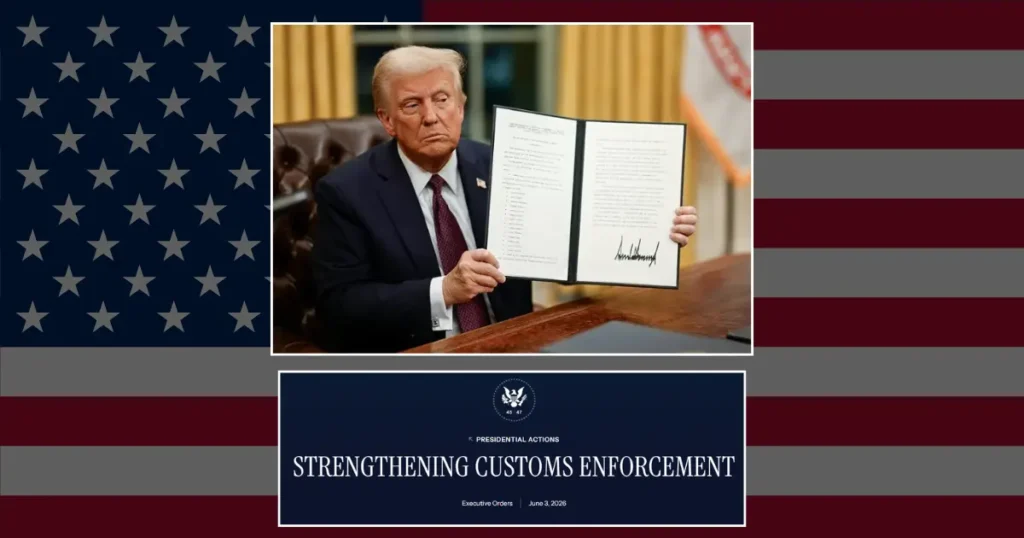
“Importing into the U.S. has for too long been treated as a right and not a privilege.” — CBP Commissioner Rodney Scott, June 3, 2026
This article breaks down what changed, why it matters, and what questions businesses should be asking before the deadlines arrive.
What Does Trump’s 2026 Customs Executive Order Actually Do?
At its core, the executive order draws a hard line between two categories of importer: U.S.-based importers of record (IORs) and foreign importers of record.
Until now, that distinction mattered relatively little for most small and medium-sized foreign exporters. The informal entry process, a low-friction and low-cost pathway for bringing goods into the U.S., was available to essentially anyone. Customs bonds could be purchased annually, covering an entire year’s worth of shipments under a single policy. The system was manageable.
That is changing.
Under the new order, foreign importers of record are prohibited from filing informal entries entirely. For formal entries, the requirements are significantly tougher. Foreign IORs must now post a single-transaction bond for every shipment. They must provide mandatory supply chain disclosures and foreign tax identification. In many cases they are also required to use a CTPAT-validated and licensed U.S. customs broker for every single entry.
It’s worth noting that the new bonding and domestic asset requirements are not exclusive to foreign importers. The order directs CBP to require all IORs, U.S. and foreign alike, to maintain a minimum level of tangible domestic assets, bonding, or both, for both formal and informal entries. Foreign IORs simply face the steeper version of this, on top of losing access to informal entry and continuous bonds.
The penalty floor for non-compliance is set at a minimum of 50% of the assessed amount, with no mitigation available for repeat offenders.
The Department of Homeland Security and U.S. Customs and Border Protection (CBP) are operating on two deadlines:
- September 2026 – CBP must begin requiring foreign exporters to submit documentation they were required to provide to their home customs administration prior to export. This intermediate deadline affects exporters sooner than most realize.
- Late 2026 – Full implementation of the revised IOR eligibility and compliance framework, including new bonding requirements, domestic asset requirements, and heightened vetting procedures.
How Does a Customs Bond Work and Why Does This Change Matter?
To understand why this order hits small foreign exporters so hard, it helps to understand how customs bonds actually work.
Think of a customs bond like business insurance. A licensed surety company guarantees to CBP that if an importer fails to pay duties or violates customs regulations, the surety will cover the cost. The importer pays a premium, typically around 0.5 to 1% of the bond’s coverage value, and CBP has financial assurance that the rules will be followed.
Under the previous system, most regular importers purchased a continuous bond, one annual premium covering unlimited shipments for a full year. For a small business shipping regularly to U.S. customers, this was affordable and predictable. A company shipping 50 times a year paid once.
The new order pushes foreign IORs toward single-entry bonds, a separate bond purchased for every individual shipment. The math changes dramatically. That same company now buys 50 bonds. A customs broker must be engaged for each formal entry. Documentation requirements multiply. Administrative costs compound.
For a small manufacturer in Alberta shipping $8,000 of product at a time to U.S. distributors, the economics can move from workable to unworkable very quickly. The same pressure applies equally to businesses in the UK, Australia, Germany, or anywhere else exporting regularly into the U.S. market.
Is This Connected to the End of the De Minimis Exemption?
Yes, and understanding the connection matters.
Earlier in 2025, the U.S. significantly restricted the de minimis exemption, the longstanding rule that allowed goods valued under $800 to enter the U.S. duty-free with minimal customs scrutiny. That rule had been a critical lifeline for small foreign e-commerce sellers shipping directly to U.S. customers. It is now gone or severely curtailed for most product categories.
The June 2026 customs enforcement executive order closes the second door.
Previously, a foreign company had two relatively accessible pathways into the U.S. market:
- Keep shipments under the de minimis threshold, no duties, minimal paperwork
- Ship larger amounts as a foreign importer of record using informal entry, manageable process, annual bond
Both pathways are now being closed simultaneously. The policy direction from Washington is consistent and deliberate: if you want to sell into the U.S. market at meaningful scale, you need a legitimate U.S. presence.
Washington Is Sending a Clear Message to Foreign Businesses
The customs EO did not arrive alone. One day earlier, the Office of the U.S. Trade Representative proposed new tariffs targeting 60 trading partners, including Canada, the EU, China, and the UK. This was over concerns that those countries had not done enough to stop goods made with forced labor from entering global supply chains. For Canadian exporters the picture is more nuanced. Most Canadian goods that qualify under CUSMA are exempt from the proposed tariffs, which is the large majority of Canadian exports to the U.S. These tariffs are not yet in effect. They are still in a public comment period and have not been finalized. But the timing is not a coincidence. Washington is applying pressure on multiple fronts simultaneously.
The timing and direction are hard to miss. The de minimis changes, the new IOR requirements, and the forced labor tariff proposal landed within weeks of each other, alongside continued pressure around tariffs and trade terms more broadly. Taken together, they point toward the same conclusion for foreign businesses: low-friction access to U.S. customers is shrinking, and the businesses that adapt early will be better positioned than those that wait.
For international businesses that have built their models around open, low-friction access to U.S. customers, the time to reassess that structure is now.
What Does “U.S. Presence” Actually Mean Under the New Rules?
The White House fact sheet confirms that the executive order requires foreign importers of record to maintain a minimum level of tangible domestic assets, bonding, or both. The precise thresholds will be defined in the regulations CBP writes before the end of 2026, so the exact bar is still being set.
What is already clear is that a U.S.-based legal entity, a properly formed U.S. LLC or corporation with a real commercial address, is the foundational first step toward qualifying as a domestic IOR. Without that structure, a foreign company has no pathway to the more favorable domestic importer treatment.
A Wyoming LLC has become a widely used choice for international entrepreneurs establishing U.S. business presence. Wyoming offers no corporate income tax, no personal income tax, strong business privacy protections, no residency or citizenship requirements for LLC formation, and some of the most flexible business laws in the country. It is consistently cited as the best U.S. state for international business formation.
It is the same reasoning that led us to establish MicroOffice Solutions in Casper, Wyoming. The state’s business formation advantages are not just theory. They are why international entrepreneurs are increasingly choosing Wyoming over Delaware or Nevada when building their U.S. presence.
MicroOffice Solutions helps international entrepreneurs with Wyoming LLC formation and provides real commercial office space, the kind of legitimate U.S. address that banks, payment processors, and now customs authorities are looking for.
That said, a Wyoming LLC alone is not a customs compliance solution. It is the foundation, the structure that makes everything else possible. Businesses navigating the new IOR requirements still need to work with a licensed customs broker and potentially a trade attorney to ensure their full structure meets CBP’s requirements once the November regulations are finalized.
There are also other tools worth understanding, including Foreign Trade Zones, bonded warehouses, and third-party logistics structures, that may offer meaningful advantages for businesses with significant U.S. import volumes. A licensed customs broker is the right starting point for understanding which options apply to a specific situation.
What Should International Businesses Do Before the Deadlines?
1. Find out your current IOR status.
Are you filing as a foreign importer of record today? Is your business structured to qualify as a U.S.-based IOR under the new rules? If the answer is unclear, that is the first question to put to a licensed customs broker.
2. Talk to a customs broker now, not in October.
Licensed brokers with cross-border experience are the primary experts on importer of record requirements and bonding structures. Many offer initial consultations at no cost. The late 2026 deadline will create a rush, so getting ahead of it is the right call. Brokers with strong cross-border track records include Buckland Customs and GHY International, though any licensed CBP broker with cross-border experience is a good starting point.
3. If you don’t have a U.S. legal entity, explore forming one.
A Wyoming LLC with a legitimate commercial address is widely considered the foundational first step for foreign businesses working toward U.S. importer status. It is not the complete solution, but without it there is nothing to build on.
4. If your import volume is significant, ask about additional options.
For businesses doing meaningful annual U.S. import volumes, tools like Foreign Trade Zones can offer duty deferral and reduced administrative burden. Ask a qualified customs broker whether any of these structures make sense for your specific situation.
5. Watch the November 30, 2026 CBP regulatory release.
The executive order sets the policy direction. The regulations CBP publishes will set the specific thresholds, including exactly what qualifies as sufficient domestic assets for foreign importer of record purposes. That detail matters enormously. Stay informed.
The Bigger Picture
This executive order is not an isolated event. The de minimis changes, the new IOR requirements, the forced labour tariff proposal, the ongoing tariff environment, the USMCA renegotiation pressure — all of it points in the same direction.
The U.S. is deliberately raising the cost and complexity of operating as a foreign business in its market. That creates genuine pain for exporters who built their models around the old rules. It also creates real competitive advantage for those willing to adapt, to establish proper U.S. structure, build compliant operations, and get ahead of deadlines that will catch many by surprise. The businesses that move now will not just survive the new rules. They will be better positioned than every competitor that waits until October to start asking questions.
Kroll, one of the world’s leading risk and financial advisory firms, put it plainly in their analysis of EO 14411:
“The Strengthening Customs Enforcement executive order may not dominate trade headlines the way tariff announcements do. But for companies that import goods into the United States, it may ultimately represent a more durable shift in the operating environment than any of the tariff actions taken during this Administration.”
Frequently Asked Questions
What is the Trump customs executive order signed in June 2026?
President Trump signed the Strengthening Customs Enforcement executive order (EO 14411) on June 3, 2026, directing CBP to overhaul how foreign importers of record are vetted, bonded, and held accountable. Key deadlines are September 1 and November 30, 2026.
Can foreign businesses still sell goods in the U.S. after this order?
Yes. The order does not prohibit foreign businesses from selling in the U.S. It significantly increases the compliance requirements and costs for foreign importers of record, and creates strong incentives to establish a U.S.-based legal entity.
What is an importer of record and why does it matter now?
The importer of record (IOR) is the entity legally responsible for ensuring goods entering the U.S. comply with customs laws and that applicable duties are paid. Under the new order, foreign IORs lose access to informal entry and face substantially higher bonding and documentation requirements than U.S.-based IORs.
What is the difference between a continuous bond and a single-entry bond?
A continuous bond is an annual policy covering unlimited shipments, one premium, one year, unlimited entries. A single-entry bond is purchased per shipment. The new order pushes foreign IORs toward single-entry bonds, significantly increasing per-shipment costs for businesses that ship frequently.
Does a Wyoming LLC qualify a foreign business as a U.S. importer of record?
A Wyoming LLC with a legitimate U.S. commercial address is a foundational first step toward qualifying as a U.S.-based IOR. It is not a complete compliance solution on its own. Working with a licensed customs broker and trade attorney is essential to build the full structure CBP will require under the new regulations.
What is the de minimis exemption and how does it relate to the Strengthening Customs Enforcement order?
The de minimis exemption previously allowed goods valued under $800 to enter the U.S. duty-free with minimal scrutiny. It was significantly curtailed in 2025. The June 2026 customs executive order is a separate but related development. Together they close the two main low-friction pathways foreign businesses have used to access the U.S. market.
What are the key deadlines for the new customs rules?
The order operates on two timelines. Within 90 days, around early September 2026, CBP must begin implementing initial disclosure and certification requirements. Within 180 days, around late November to early December 2026, the full revised IOR framework must be in place, including new bonding requirements, domestic asset thresholds, and heightened vetting procedures. CBP could act sooner than either deadline through guidance or operational directives.
Who should I contact first if my business exports to the U.S.?
A licensed U.S. customs broker with cross-border experience is the right first call. They can assess your current IOR status, explain your bonding options, and advise on whether additional structures like a U.S. LLC or Foreign Trade Zone arrangement make sense for your volume and product type.
This article is for informational purposes only and does not constitute legal or customs compliance advice. Businesses navigating U.S. import requirements should consult with a licensed customs broker and qualified trade attorney.
Sources: White House Fact Sheet / Executive Order / CBP Press Release / Mayer Brown / Lexology / Buckland Customs / GHY International / CM Trade Law / U.S. Foreign-Trade Zones Board / CBC News: Forced Labour Tariffs Explained Kroll: Rules Just Changed-What the New Customs Enforcement Executive Order Means